Storage Ideas
Under-Bed Storage Ideas That Do Not Turn Into Hidden Clutter
Use under-bed storage wisely with simple rules for bins, labels, seasonal items, and categories worth keeping below the bed.
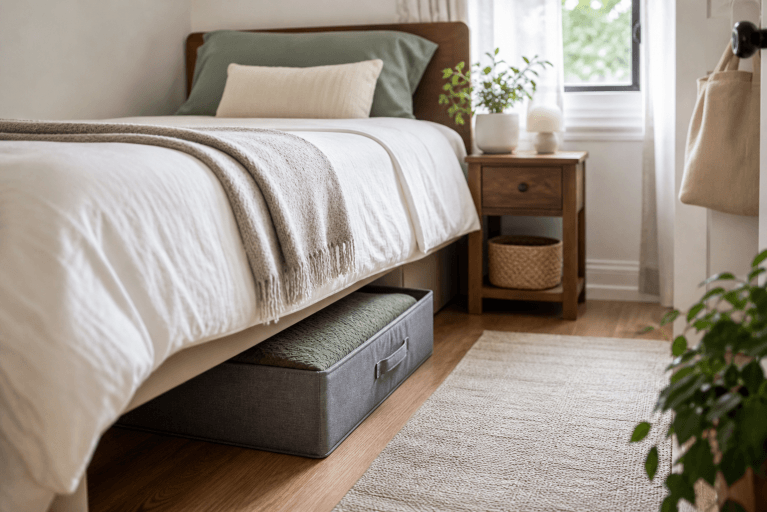
Under-bed storage has a bad reputation for a fair reason. It can become the place where uncertain items disappear: shoes without mates, old papers, gift bags, half-used hobby supplies, bedding nobody reaches for, and boxes that get opened once a year with mild regret.
But in a small bedroom, the space under the bed can be useful. The difference is whether it has a narrow job. Under-bed storage should hold categories you need to keep but do not need every day. It should not become a second junk room lying flat on the floor.
Decide Whether The Space Is Worth Using
Not every bed should have storage underneath. If the room is dusty, the bed sits too low, or pulling bins out requires moving furniture every time, the space may create more work than it solves.
Check three things before storing anything:
- Can a container slide in and out without scraping or lifting the bed?
- Can you clean around the area?
- Can you see or label what is inside?
If the answer is no, use the space lightly or skip it. Storage that is hard to reach should not hold items used often.
Choose The Right Categories
Good under-bed categories are seasonal, contained, and not needed in a hurry.
Useful choices include off-season clothing, spare sheets, guest bedding, extra blankets, sentimental items in a limited box, seasonal shoes, or occasional hobby supplies that are already grouped.
Poor choices include daily shoes, loose paperwork, random cables, food, fragile items, heavy boxes that are hard to pull, or anything you need every week.
The space under the bed is low and slightly awkward. Let that awkwardness decide what belongs there.
Use Containers With A Clear Limit
Loose under-bed storage almost always becomes hidden clutter. Use containers with lids, zippers, wheels, handles, or firm sides depending on your floor and bed height.
The container does not have to be expensive. What matters is that it fits the space, protects the category reasonably, and can be pulled out without dumping the contents.
Measure before buying anything. Check the height from floor to bed frame, the width available between legs or supports, and the clearance needed to pull a bin out. A container that technically fits but catches every time will be avoided.
Label For Retrieval, Not Decoration
Labels are useful when the container is not transparent. Keep labels plain: “winter sweaters,” “guest sheets,” “summer shoes,” “keepsakes.” A label should tell you what is inside without opening the box.
Avoid vague labels like “miscellaneous” or “extras.” Those words do not help future decisions. If a category cannot be named, it may need sorting before storage.
Place the label where it can be read from the side you pull. A perfect label on the lid is not helpful if the bin stays under the bed.
Keep Daily Life Away From The Floor
Under-bed storage should not interfere with making the bed, walking, opening drawers, or cleaning. Leave a little space around the bed if possible. If bins stick out or force the bed skirt to bulge, the room will feel more crowded.
Avoid storing items so tightly that every retrieval becomes a project. Two easy bins usually work better than five squeezed-in containers.
If the bed is against a wall, store the most likely-to-be-used container on the open side. The far side should hold the least-used items.
Review It Seasonally
Under-bed storage needs a review because it is out of sight. Tie the review to a natural moment: changing bedding, switching seasons, moving winter clothing, or preparing for guests.
Pull out one container at a time. Remove anything that no longer fits your life, belongs elsewhere, or has turned into a delayed decision. Wipe or vacuum the area before sliding containers back.
If a container has not been opened in a year, ask whether the contents still deserve space in a small bedroom.
When Under-Bed Storage Is The Wrong Answer
Skip under-bed storage for items that need ventilation, frequent access, or careful temperature conditions. Avoid storing anything unsafe, unstable, or likely to leak.
Also skip it if the bedroom already feels visually heavy. Sometimes a clear floor line under the bed makes a small room feel calmer than another row of bins.
If the under-bed area becomes a place to avoid decisions, move those items into a visible decide-later box with a review date instead.
Mistakes To Avoid
The biggest mistake is storing loose items under the bed. If it does not have a container and a category, it will be hard to find and harder to clean.
Another mistake is using the space for daily items. Daily storage should be reachable without kneeling, pulling, and sorting.
It is also easy to overfill the area because it is hidden. Hidden storage still counts as storage.
Finally, do not buy bins before measuring. Under-bed clearance can be surprisingly unforgiving.
Read Next
- How to Organize a Small Bedroom Without Buying More Furniture
- How to Declutter a Closet When You Have Very Little Storage
- How to Store Seasonal Items in a Small Home