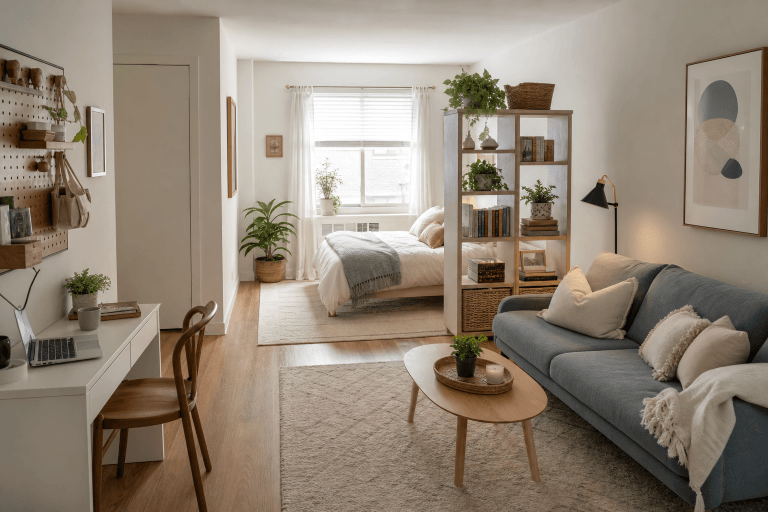
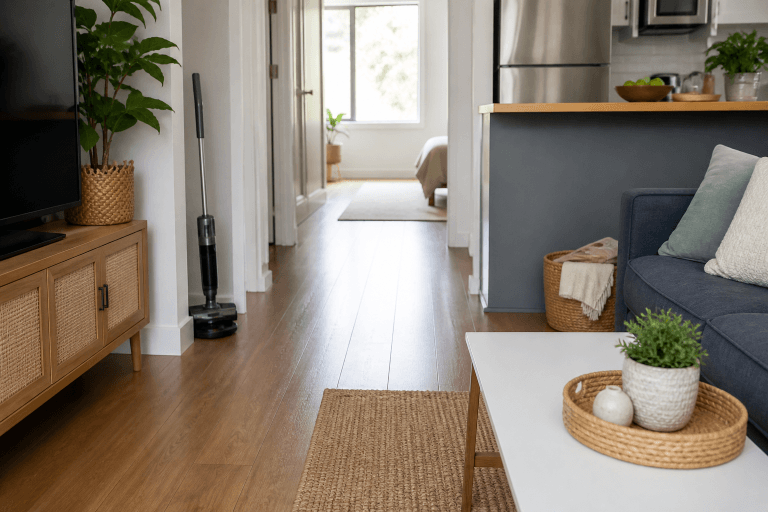
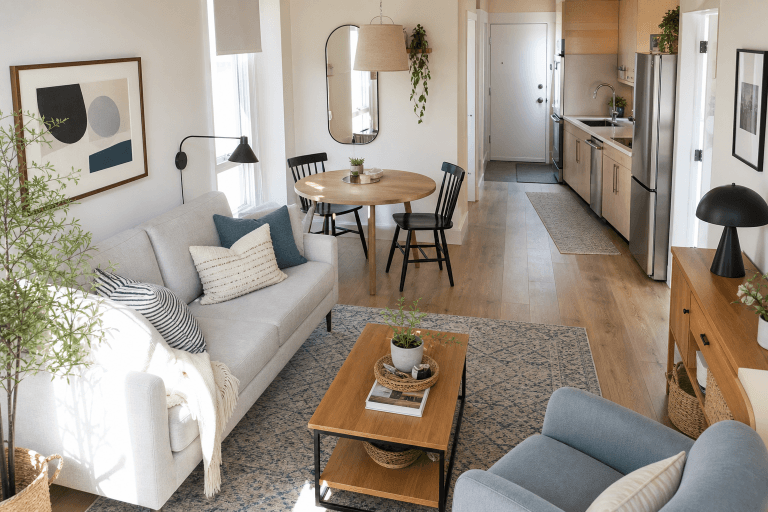
Small-Space Living
Small Space Living: A Practical Guide to Making a Tiny Home Feel Bigger
Practical ways to make a small home feel bigger, calmer, and easier to live in without major renovations or expensive furniture.
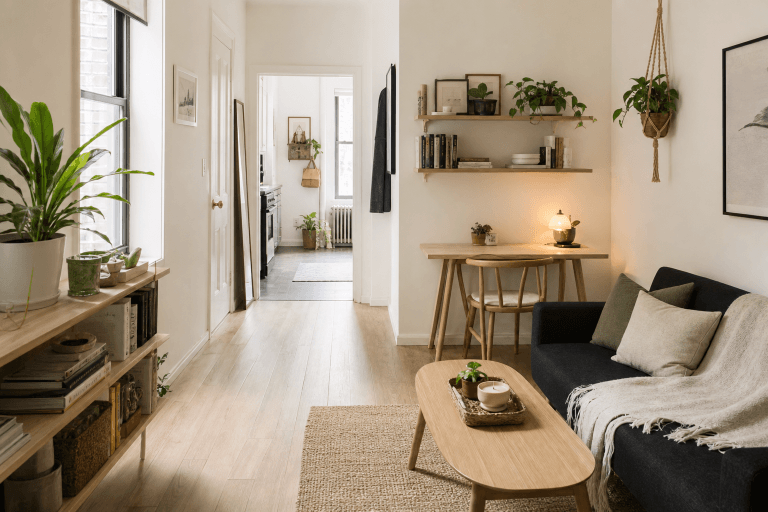
A small home usually tells on itself in the annoying moments. The closet door cannot open because a hamper is in the way. A chair near the bed becomes a second closet. The coffee table is technically clear, except for the mail, a charger, two mugs, and the thing you meant to return last week.
That is the part of small-space living that gets missed in tidy room photos. A compact home does not only need to look open. It has to work when you are carrying groceries, getting dressed half-awake, looking for keys, or trying to cook dinner on one usable patch of counter.
So the question is not, “How do I make this place look bigger?” A better question is, “Where is this home making ordinary life harder than it needs to be?”
The fixes below are about clearing pressure points: the places where your home repeatedly jams up.
Start With The Spot You Keep Avoiding
Most people know the one spot. It might be the narrow strip between the bed and the wall, the entryway where shoes spread out, the kitchen cabinet that spits containers back at you, or the corner where a desk was supposed to make working from home feel contained.
Start there, not with the whole apartment.
Pick one area that irritates you daily and remove everything that does not support that area. If it is the entry, take away the shoes that are not being worn this week, the old shopping bags, the packages waiting for a decision, and the jacket that keeps sliding off the hook. If it is the bedroom chair, sort only what is on the chair. Do not open the entire closet yet.
Small homes punish half-finished projects. Emptying every cabinet may feel productive for the first hour, then suddenly your apartment is covered in piles and you have to live around the mess. A smaller fix that actually gets finished is usually more useful.
Once the problem area is clear, ask what keeps returning. Shoes need a tighter limit. Mail needs a landing spot. Rewear clothes need a place that is not the chair.
Clearance Beats Clever Storage
Small homes often feel cramped because the walking path is compromised. Not blocked completely, just pinched enough that you notice it all day.
A stool by the kitchen, a plant stand near the window, a floor basket beside the sofa, a shoe rack that sticks out too far: each one may be reasonable on its own. Together, they make the room feel like something has to be negotiated every time you move.
Walk the route from the front door to the sofa, kitchen, bathroom, and bed. Do it while carrying something bulky, such as a laundry basket or grocery bag. If you have to twist, lift, or pause, the room is giving up comfort for an object that may not deserve it.
The first edit is usually not glamorous:
- Move one floor basket.
- Take away the extra stool.
- Slide a small table out of the doorway’s swing.
- Keep only current shoes at the entrance.
- Stop storing “temporary” things in the path.
This is also where furniture earns or loses its place. A coffee table that leaves only a tight walkway may be the wrong shape. A side table that catches your hip twice a day is not harmless. A bench at the foot of the bed may look finished, but if it turns the bedroom into a shuffle, it is asking too much from the room.
Here is a useful measuring habit before moving furniture: check the clearance you actually need, not just the empty floor on a plan. These are comfort checks, not building-code or accessibility requirements. Around a bed, about 24 inches of walking space can still feel tight if a drawer opens into it. In front of a cabinet, leave room for the door or drawer plus your body. Near an entry door, account for the door swing, shoes, and the bag you are carrying. A 36-inch-deep sofa may be comfortable, but in a narrow living room it can quietly take the whole walkway.
If you are deciding between two pieces, tape the footprint on the floor first. Walk around it for a day before committing.
Give Surfaces Less To Decide
Open surfaces are useful in small homes. They are also where undecided things tend to land.
A dresser top becomes a holding area because putting things away takes effort. A kitchen counter collects paper because the entry has no better place for it. A nightstand grows a stack of books because choosing the next book feels easier than returning the old ones.
Instead of trying to keep every surface empty, give each one a narrower job.
The entry shelf can hold keys, sunglasses, and outgoing mail. The nightstand can hold a lamp, water, glasses, and one current book. The kitchen counter can keep the coffee setup if it is used every morning, but it should not also become the snack shelf, paper tray, and tool bench.
One surface at a time, remove everything and put back only what belongs to that spot. Useful things still need to live where they are used.
Be careful with trays. They can make small clutter look calmer, but they can also become permission to keep too much. A tray should create a limit. When the tray is full, it is time to reset it, not upgrade to a larger tray.
Use this quick audit when a room feels crowded but you cannot tell why:
| Area | What To Check | Better First Move |
|---|---|---|
| Entry | Shoes, bags, mail, packages | Limit visible shoes and add one landing spot |
| Main path | Stools, baskets, plant stands, table corners | Remove one floor item for a week |
| Kitchen counter | Paper, snacks, appliances, dishes | Protect one clear food-prep section |
| Bedside | Clothes, books, cups, chargers | Create a rewear spot and keep one current book |
| Open shelves | Packed bins, packaging, too many small objects | Close away one category or leave one shelf looser |
One Bad Piece Can Shrink The Whole Room
It is tempting to blame the apartment. Sometimes the real problem is one piece of furniture that has too much authority.
The sofa may be too deep for the living room. The dining table may be kept for a life that rarely happens. A bookcase may hold useful things but still make the room feel heavy because it sits in the darkest corner and reaches almost to the ceiling. A storage ottoman may sound practical until you have to clear it every time you need what is inside.
Do not judge furniture only by whether it fits. Judge it by what it costs.
Does it block a door, window, heater, outlet, or cabinet? Does cleaning around it require moving three other things? Does it make you store something daily in an awkward place? Does it create more surface clutter than storage relief?
If you are unsure, do a temporary removal. Move the piece out of the room for a few days if you can. If the room instantly feels easier, you have learned something useful.
For renters, this matters more than built-in storage. You may not be able to change the walls, but you can often change which furniture gets prime space.
Sample layout: a narrow studio entry
In this sample layout, the front door opens directly into the living area. There is no hall closet, only a wall strip beside the door and about three feet before the sofa begins. The tempting fix is a bench with baskets underneath. It looks useful, but it makes the door area feel crowded, and shoes still spill out because the baskets are awkward to pull.
A simpler setup may work better: three daily shoe spots under a slim shelf, one hook for the current bag, and a small tray for keys and mail. Less storage, but fewer steps. The best storage matches the tightest moment in the room.
Use The Wall, But Do Not Turn It Into A Supply Closet
Vertical storage is helpful until it makes the wall feel crowded.
Hooks, shelves, rails, and tall bookcases can rescue a small home when they remove a daily problem. A hook by the door for a work bag makes sense. A narrow shelf near a desk can keep notebooks and chargers off the table. An over-door organizer can help when the closet is short and the items are light enough for that kind of storage.
But wall storage should not become a way to display every unresolved category. If a wall holds bags, hats, keys, coats, cleaning tools, plants, books, and a few decorative objects, it may technically be organized and still feel crowded.
Keep the most visible wall areas edited. Put less attractive or less frequent items in closed containers where possible. Leave some blank wall around shelves and hooks.
If you rent, check your lease before drilling or mounting hardware. Pay attention to wall type and weight limits. When that feels uncertain, use freestanding pieces: a narrow bookcase, a leaning shelf, a cabinet with doors, or a storage piece that can move with you.
The best renter-friendly solution is not always the one with no holes. Sometimes it is the one you will actually remove cleanly, use safely, and not overload.
Build Zones Around The Mess, Not Around A Floor Plan
Studio apartments and small one-bedrooms are often told to create zones: sleeping zone, work zone, dining zone, relaxing zone. That advice is useful, but only if the zones match real life.
If you work from the sofa most evenings, the sofa is part of the work zone whether you planned it or not. If you open mail in the kitchen, the kitchen needs a paper decision spot. If you get dressed beside the bed, the bedroom needs a small system for clean, dirty, and can-wear-again clothes.
This is where a zone becomes practical instead of decorative.
A sleeping zone might mean the bed is easy to make and the nightstand is not a storage pile. A work zone might mean your laptop, charger, notebook, and headphones can disappear into one drawer or box when the day is done. A dressing zone might be as simple as a hamper, a hook, and one clear drawer that is not packed shut.
Do not make zones for imaginary routines. A tiny dining corner used twice a month does not need to dominate the room. Let the apartment admit how it is actually used.
Keep The Awkward Stuff Close
The least photogenic items usually decide whether a small home stays tidy: chargers, reusable bags, shoes, half-worn clothes, mail, cleaning cloths, spare towels.
Give those items small, plain homes.
Mail does not need a beautiful command center. It may need one tray near the place where envelopes are opened. Rewear clothes do not need a full wardrobe strategy. They may need two hooks behind the bedroom door or a small basket that gets emptied before laundry day. Shoes do not need a large rack if the entrance can only handle three daily pairs.
This is also where large containers backfire. A big basket can make clutter disappear for a while, but it hides the limit. A smaller container tells you sooner when the category is outgrowing the space.
There is nothing wrong with a home that has visible useful things. The problem starts when a category has no limit.
Small-Space Advice To Treat Carefully
Some popular small-space advice is not worth starting with.
Matching bins can help later, but they make the least difference if the room still has blocked paths and overfilled surfaces.
Open shelving is not automatically an upgrade. It needs editing, or it becomes clutter at eye level.
Avoid buying a large storage piece before measuring door swings, walking paths, and the space needed to pull out drawers. A cabinet can be beautiful and still make the room worse.
Be cautious with “hidden storage everywhere.” Hidden storage is useful for defined categories. It is less useful when every ottoman and under-bed box becomes a place to delay decisions.
The boring order works better: clear the route, reduce surface clutter, fix one annoying category, then decide whether you need more storage.
A Reset That Survives A Normal Weekend
A realistic reset should leave the home usable even if you stop halfway. That is the test.
Start with the front door and the path through the room. Move anything that makes you step around it. Then clear one food-prep surface, one bedroom surface, and the place where bags or mail collect. Put trash, recycling, donations, and belongs-elsewhere items into separate bags or baskets.
Stop there if you are tired. The home is already easier to use.
If you have another short stretch, fix three repeat offenders. Pick from keys, shoes, mail, laundry, chargers, toiletries, or reusable bags. Put a small home near the place each item naturally lands. Do not create a complicated system. The goal is to make the next ordinary day easier, not to finish the apartment forever.
When you are done, walk through the home carrying something. If you can move more easily than before, the work counted.
Common Mistakes That Make A Small Home Feel Tighter
The first mistake is treating storage as the answer to every problem. Sometimes the answer is less furniture, fewer visible objects, or a clearer path.
Another mistake is storing things where they “should” go instead of where they are actually used. A paper system in a desk drawer will not help if all paper enters the home at the kitchen counter.
It is also easy to make the room look organized but not easier. Packed shelves, labeled bins, and tidy baskets can still be too much if daily items are hard to reach.
Finally, avoid systems that require a full reset every time. Small homes need maintenance, but they should not need a weekly rescue operation.
Next, Fix The Rooms That Usually Cause Trouble
- How To Make A Studio Apartment Feel Like Separate Rooms
- How to Organize a Small Bedroom Without Buying More Furniture
- Small Apartment Layout Ideas for Better Flow
- How to Make a Small Room Feel Less Busy