Room-by-Room
Small Entryway Storage Ideas for Apartments Without Mudrooms
Practical entryway storage ideas for shoes, bags, keys, coats, and mail when your apartment has no mudroom or hall closet.
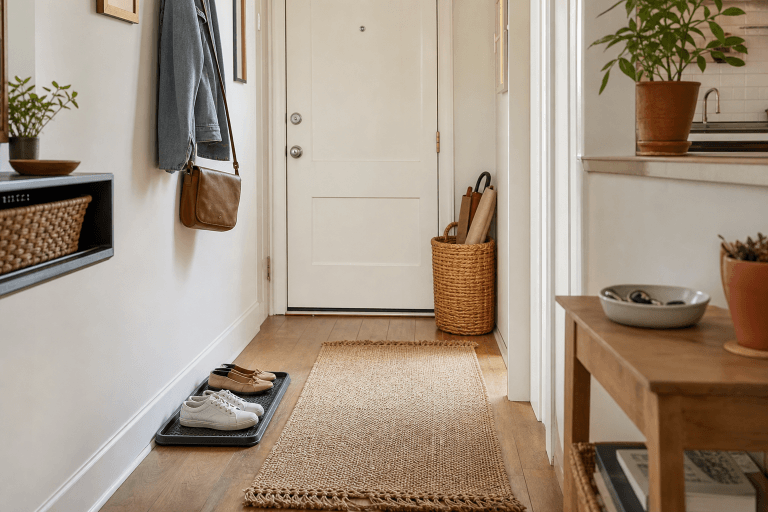
Some apartments do not have an entryway. The door opens, and you are in the living room, kitchen, or a narrow strip of wall that has to pretend to be a mudroom. That is enough space for clutter to happen, but not always enough space for normal entry furniture.
The goal is not to build a full mudroom out of nothing. It is to make arriving and leaving less messy. Shoes need a limit. Keys need one home. Bags need somewhere to pause. Mail needs a decision spot before it reaches the kitchen counter.
Start With A Doorway Walkthrough
Stand outside the apartment door with the things you usually carry: keys, bag, coat, mail, groceries, or work items. Open the door and notice where your hands naturally want to drop things.
That landing behavior matters more than a beautiful layout. If keys always land on the nearest shelf, put the key spot there. If shoes come off immediately, make shoe storage close to the door. If mail gets opened in the kitchen, either move the mail spot closer to the kitchen or accept that the kitchen needs a small paper tray.
Check the door swing before buying anything. A bench, shoe rack, or basket that blocks the door is not entry storage. It is furniture in the way.
Limit Shoes Instead Of Storing Every Pair
Most small entries cannot hold all shoes. They can hold current shoes.
Choose a daily shoe limit based on the space. That may be two pairs per person, one pair per person, or only the shoes used most often. Move the rest to a closet, bedroom, or under-bed container.
Good shoe storage for tiny entries is shallow and easy to reset. A slim rack, low tray, small cubby, or clear floor boundary can work. Avoid tall shoe towers if they make the entrance feel crowded or catch bags when people walk through.
Wet or dirty shoes need a practical surface. Use a tray or washable mat if it suits your floor and lease rules. Keep it small enough to clean.
Give Keys A Place That Cannot Drift
Keys need the most boring storage in the apartment. A dish, hook, small tray, or drawer near the door is enough.
Do not combine keys with every small item you own. If the key dish also holds coins, receipts, lip balm, batteries, earbuds, and old tags, keys will disappear inside their own home.
Use a one-hand rule. The key spot should work while holding groceries or a bag. If it requires opening a box, moving mail, or reaching behind decor, it will not be used on tired days.
Choose One Bag Spot
Bags cause entry clutter because they are bulky and used often. A hook can help, but only if the bag is light enough and the wall or door solution is appropriate.
If mounting is not allowed or uncertain, use a freestanding option: a narrow basket, low shelf, small stool, or a spot inside a nearby closet. Keep the bag location close to where the bag is dropped.
Do not hang every tote bag at the entry. Keep the current work bag, everyday purse, backpack, or one reusable bag. Store extras elsewhere. A row of full bags can make a small doorway feel busy before anyone enters the room.
Mail Needs A Short Stay
Mail becomes apartment clutter when it has no next step. The entry does not need a full command center. It needs a short-stay spot.
Use one small tray, wall pocket, or basket for unopened mail and outgoing paper. Empty it on a regular day, not when it overflows. If paper needs action, move it to a work area. If it is junk mail, recycle it quickly. If it needs filing, do not let the entry become the file cabinet.
A small tray is better than a deep basket because it shows the pile sooner.
Coats And Outerwear Need Seasonal Editing
If there is no hall closet, visible coats can take over the entry. Keep only the current layer near the door. Store out-of-season coats, special-occasion jackets, and rarely used outerwear away from the entrance.
For renters, over-door hooks, freestanding coat racks, or a small wall hook where allowed may work. Keep weight and balance in mind. A coat rack overloaded on one side can become awkward in a tight space.
If the entry is part of the living room, consider closed storage nearby. A cabinet, wardrobe, or closet section can make the apartment feel calmer than a wall full of coats.
A Five-Minute Entry Reset
An entryway stays usable with a very short reset. Put away shoes beyond the daily limit. Empty the mail tray. Return bags to their spot. Remove packaging. Take outgoing items with you the next time you leave, or move them next to the door only when they are truly ready to go.
If the same category returns every day, adjust the storage rather than adding more. Shoes may need a stricter limit. Mail may need a smaller tray. Bags may need a lower hook or easier basket.
Mistakes That Crowd A Small Entry
The first mistake is buying a bench because every entry photo has one. A bench only helps if there is room to sit, open the door, and walk past it.
Another mistake is storing all shoes at the doorway. Current shoes belong there; the rest usually do not.
It is also easy to add too many hooks. Empty hooks look useful, but full hooks become a wall of visual clutter.
Finally, do not let outgoing items live by the door for weeks. A return bag that never leaves is no longer outgoing. It is entry clutter.
Read Next
- Renter-Friendly Wall Storage Ideas That Do Not Require Drilling
- The Complete Decluttering Checklist for Apartments
- A Room-by-Room Home Organization Plan for Busy People