Storage Ideas
How to Label Storage Bins Without Overcomplicating It
A simple labeling approach that makes bins easier to use without turning organization into a project.
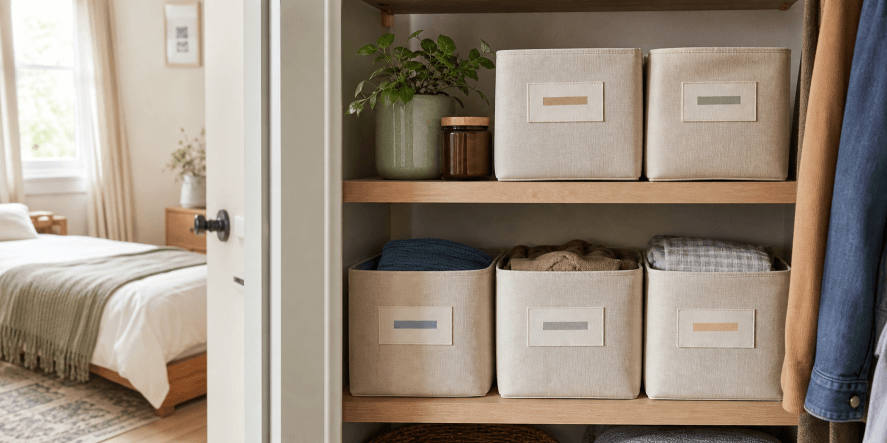
Labels are supposed to make storage easier. They can also turn into a tiny side project that delays the real work. Fonts, label makers, matching tags, perfect categories, and color systems may look satisfying, but a small home usually needs something plainer: labels that help you find and return things quickly.
The best label is the one you understand when you are tired, in a hurry, or looking for something from the back of a closet.
Label The Category, Not Every Item
Most bins do not need a full inventory. They need a clear category. “Winter hats” is useful. “Red hat, black gloves, gray scarf, earmuffs” is too much unless the bin is archival.
Use broad labels for everyday storage:
- cleaning cloths
- batteries
- gift wrap
- winter accessories
- guest sheets
- extra toiletries
- cords
- office supplies
If a bin contains several unrelated categories, the problem may not be the label. The bin may need sorting.
Avoid Vague Labels
Labels like “misc,” “extras,” “stuff,” and “random” do not help. They give clutter a place to hide.
When you cannot name the category, empty the bin and sort it. You may find three smaller categories, items that belong elsewhere, and things ready to leave.
A useful label should answer two questions: what is inside, and when would someone look here?
Use Temporary Labels First
Do not wait for perfect labels. Painter’s tape, masking tape, sticky notes, paper tags, or index cards can work while a system is still new.
Temporary labels are helpful because categories often change after a week or two. A bin labeled “desk supplies” may become “current work tools.” A basket labeled “bathroom extras” may split into toiletries and cleaning supplies.
Make the system earn a permanent label.
Put Labels Where You Actually Look
A label on the lid is not helpful when the bin sits on a high shelf. A label on the front is better for stacked bins. A side label may work for under-bed storage that pulls out from one direction.
Before labeling, place the bin where it will live. Then stand where you will search for it. Put the label where your eyes naturally land.
This small step prevents a very common problem: labeled bins that still have to be opened.
Choose Words Other People Understand
In shared homes, labels should make sense to everyone who uses the storage. “Kitchen backups” may be clearer than “overflow.” “School papers” may be clearer than a child’s name if the papers are shared household records.
Avoid private shorthand unless the bin is only for you. The point is to reduce explaining.
Keep Pretty Labels Secondary
Good-looking labels are fine, but appearance should come after clarity. If handwritten tape solves the problem, use it. If a label maker makes the system easier to read, use that. If matching tags make you delay organizing for another week, skip them.
In a small home, the label’s job is not decoration. It is retrieval.
Review Labels When Storage Drifts
If a bin keeps collecting the wrong items, the label may be too broad, too hidden, or no longer accurate. Rename it. Split the category. Move the bin closer to where the items are used.
Labels are not contracts. They are working notes for the home.
When Not To Label
Some storage does not need labels. A clear bin of toilet paper, a basket of current blankets, or a drawer that holds only socks may be obvious enough. Labeling everything can make a simple home feel over-managed.
Use labels where forgetting costs time: high shelves, opaque boxes, under-bed bins, seasonal storage, shared supplies, and categories used less often. Leave obvious daily storage alone.
Keep Reading
- How to Store Seasonal Items in a Small Home
- Under-Bed Storage Ideas That Do Not Turn Into Hidden Clutter
- How to Declutter a Closet When You Have Very Little Storage